

At a glance
On Canton, Modulo operates as both a featured app provider and a validator operator — responsible not only for application development, but also for the underlying operational visibility required to run on a privacy-enabled network. Modulo’s Canton application includes a self-custody wallet experience for end users, with privacy at the core.
How Noves helps
- Real-time visibility into all validator and application activity on Canton
- Track traffic costs, transaction volumes, and user onboarding across transaction types
- Replaced fragile in-house scripts with a reliable, always-on data layer
- Export and query transaction data programmatically for analytics workflows
The problem
When Canton applications also carry infrastructure visibility requirements
Canton’s privacy architecture requires that each featured application operate its own validator node, so Modulo doesn’t just build a wallet — they run the underlying infrastructure too. That means the team needs constant visibility into what’s happening on their node: transaction volumes, traffic costs, user onboarding rates, Canton Coin flows, and more.
Before Noves, Modulo relied on custom scripts to parse Canton event data for reporting and operational visibility. The approach worked, but it created maintenance overhead, limited reporting agility, and made routine operational questions harder to answer quickly. There was no dashboard view. No easy way to filter by transaction type or time frame. No quick answer when someone asked, “How many users onboarded in the last 24 hours?”
For teams operating infrastructure on privacy-enabled networks, that kind of dependency on internal tooling can become an ongoing operational burden. As Anthony from Modulo put it, building an equivalent dashboard internally would take weeks of engineering time and maintenance to do in-house — and that’s assuming you already have access to the underlying data in a consumable format.
Real-time visibility
Modulo’s primary use case for the Noves Data App is straightforward: see everything that’s happening on their validator node, in real time.
Through the Noves dashboard, the Modulo team can see all transactions flowing through their node, the traffic costs associated with each, and how much Canton Coin is being spent over time. They filter by validator, by application, by time frame, and by transaction type — all through a clean UI that didn’t require a single line of custom code.
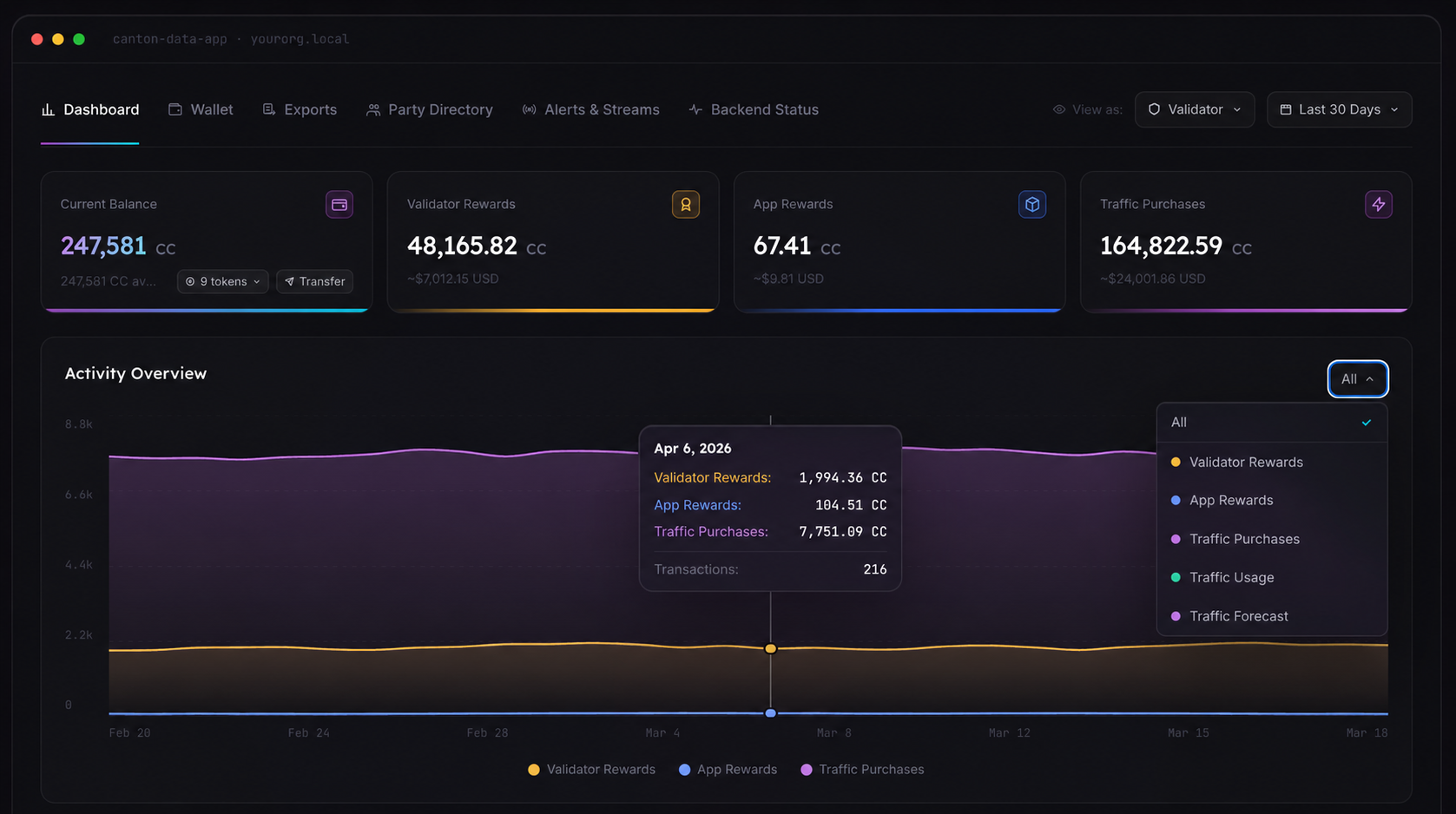
A typical workflow: filter for a specific transaction type — like transfer pre-approvals or merge delegation proposals — within a 24-hour window to quickly gauge how many new users have onboarded. A fast, visual check on ecosystem activity that previously required querying raw event streams.
“We can see all the transactions, we see the traffic costs associated with them. All of this data, if you run your own validator, you can access this data directly in the event stream and parse it yourself — but this gives you an easy interface to see all these things. It saves us a lot of time and effort from trying to replicate it.”
Transaction classification
In the early days of Canton, many transaction types coming through Modulo’s validator were unclassified or not well understood. The Noves Data App helped surface these, giving the team a way to identify and ask questions about unfamiliar activity on their node.
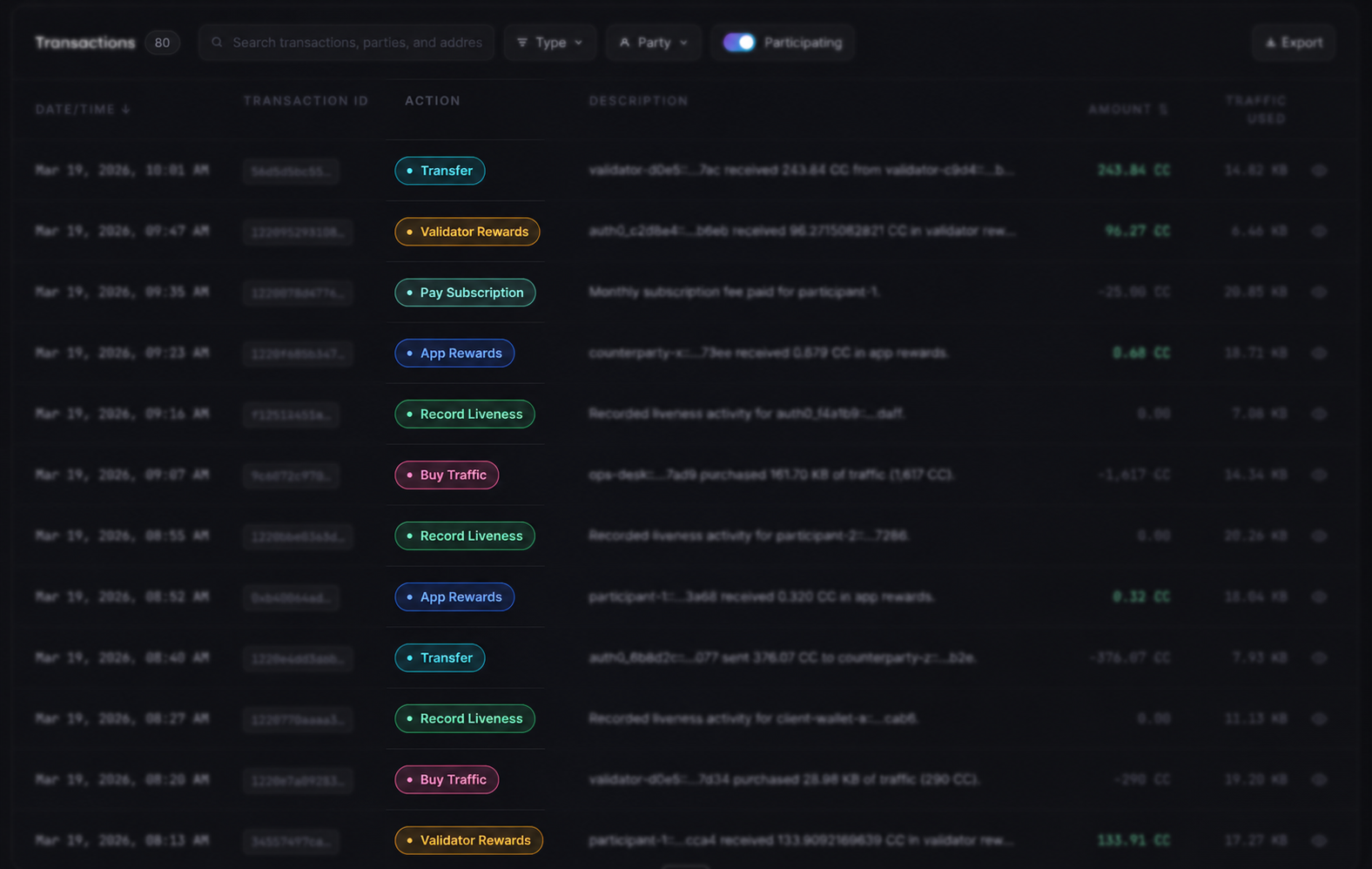
Over time, as Noves expanded its Canton transaction parsers, coverage improved to the point where virtually everything is now properly classified. What was once a discovery tool for unknown transaction types has matured into a reliable, always-current map of all node activity organized by type, with traffic attribution built in.
This matters especially on Canton, where data isolation to participant nodes means there’s no global block explorer to fall back on. Each operator needs their own observability layer — and Noves provides exactly that.
From CSV to API
Modulo’s relationship with the Noves Data App has evolved over time. Early on, the team used CSV exports to pull transaction sets for accounting and reconciliation, which was particularly useful when dealing with high-volume transaction types like merges.
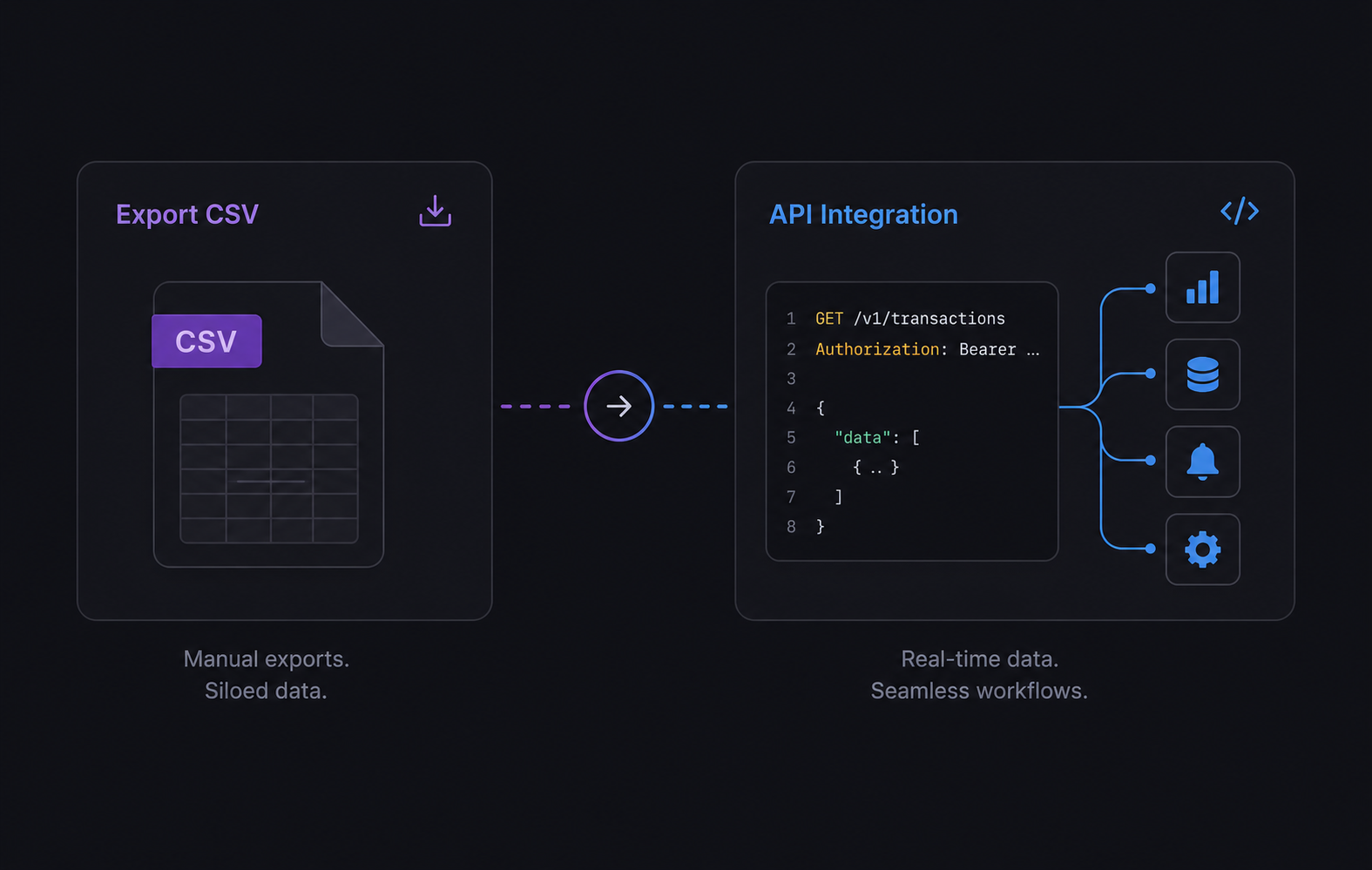
More recently, the team has shifted to using the Noves APIs directly, querying data programmatically for aggregate-level analytics. Instead of exporting files and counting rows, they now fetch data on demand — once or a few times a day — and pipe it into their own analytics workflows.
“The APIs themselves are actually very helpful. We’ve been using those more just to fetch data directly, so we don’t need to export anymore.”
This progression — from dashboard browsing, to CSV exports, to API-driven workflows — reflects the kind of incremental adoption that Noves is built for. Start with the UI, graduate to the API, build on top of the data as your needs grow.
Built-in wallet
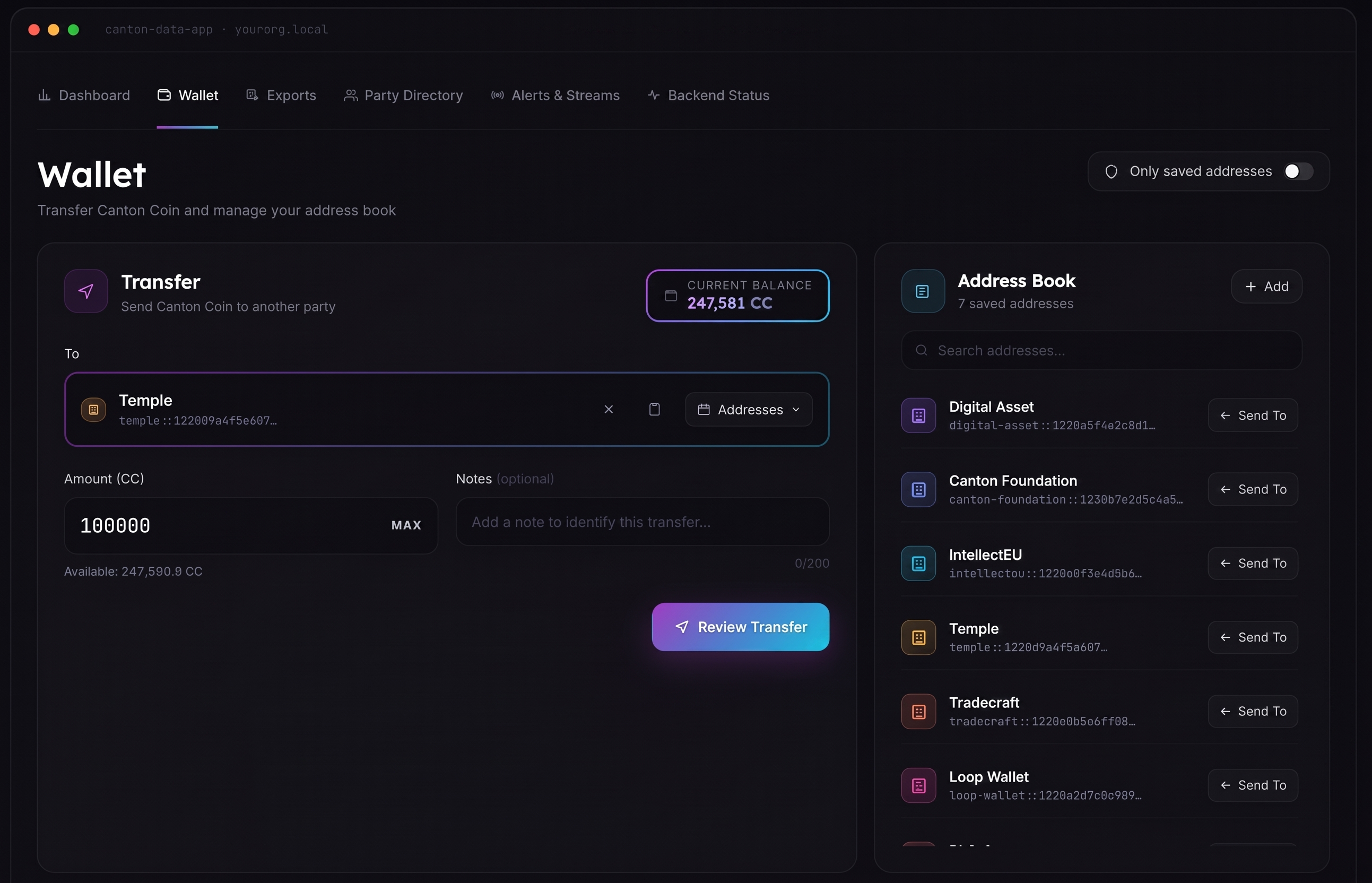
Beyond analytics, Modulo also uses the wallet functionality embedded in the Noves Data App. For quick operational tasks like sending Canton Coin to service providers, it’s often more convenient than hitting a command line. A small feature, but one that removes friction from day-to-day operations for teams that are already living inside the platform.
Noves impact
The Noves Data App has given Modulo a complete operational picture of their Canton validator without the engineering overhead of building and maintaining custom tooling. The core benefits:
- Engineering time saved: Building a comparable dashboard and data pipeline would take weeks of developer effort. Noves eliminated that entirely, letting the team focus on building their core wallet product and cross-chain protocol instead of data infrastructure.
- Real-time operational visibility: The dashboard provides an always-on view of validator activity — transaction volumes, traffic costs, Canton Coin flows, and user onboarding signals — filterable by type, time, and application.
- Flexible data access: From visual dashboard to CSV exports to direct API queries, Modulo can consume data however their workflow demands. As their analytics needs have grown, the API has become the primary integration point.
- Transaction classification out of the box: Noves maintains canonical parsers for Canton applications, so Modulo doesn’t have to build or maintain their own. As new transaction types emerge across the ecosystem, classifications are updated automatically.
As Modulo expands its Canton operations and analytics capabilities, Noves supports a more reliable operating model for monitoring, reporting, and understanding validator and application activity — without requiring the Modulo team to maintain that data infrastructure internally.
Resources
Cross-chain financial infrastructure. Featured app provider and validator operator on Canton.
Self-hosted, permission-aware operational data layer for Canton Network validators and applications.
Token balances, transfer history, and registrar metadata. Same data as the Data App, available as a hosted service.
Free developer-tier API key — the same endpoints Modulo uses in production.